Government Procurement for Civil Engineers
Municipal engineering firms compete for road reconstruction, water and sewer design, stormwater management, facility infrastructure, and rate studies from cities, counties, and special districts. These projects move through a public-record lifecycle — CIP adoption, committee discussion, design authorization, solicitation, selection — but most firms only enter the picture at the RFP stage. This guide explains where the projects start and how to find them months earlier.
Where Municipal Engineering Projects Originate
Infrastructure projects in local government begin with one of these public-record events:
- Capital improvement plan adoption. A city adopts a 5-year CIP that includes "2nd Avenue water main replacement" at $2.1M in Year 2. This is the earliest budget-backed signal.
- Public works committee discussion. The public works committee reviews a condition assessment, discusses pavement ratings, or reviews a sanitary sewer video inspection report. The discussion is in the committee packet.
- Design authorization. A council or board authorizes staff to solicit proposals for engineering design services. This is the moment before the RFQ exists.
- Rate study completion. A utility rate study identifies the capital program needed to sustain the system. Rate studies are leading indicators — a rate increase today means construction projects in 12-24 months.
- Grant or loan award. A body receives a USDA Rural Development loan, a state revolving fund loan, or ARPA infrastructure funding. The funding creates procurement momentum and a timeline.
- Contract expiration. An existing engineering services agreement approaches its term. The body must rebid or renew.
The Procurement Timeline
| Stage | Typical lead time before RFP | Where the signal appears |
|---|---|---|
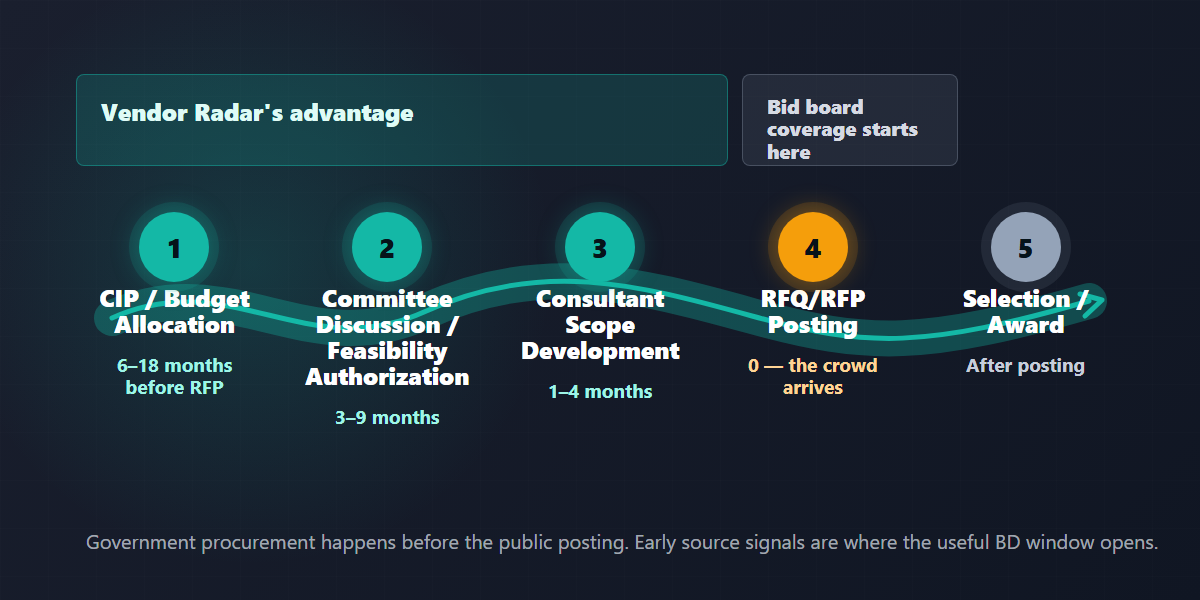
| CIP inclusion / budget allocation | 6–24 months | CIP document, annual budget, board resolution |
| Condition assessment / rate study | 6–18 months | Committee packet, staff report, consultant report |
| Committee discussion / design authorization | 2–9 months | Public works committee minutes, council action items |
| RFQ/RFP posting | 0 (every firm sees it here) | QuestCDN, procurement page, bid board |
| Selection / award | After posting | Council minutes, procurement page |
The firms that consistently win municipal engineering work enter the picture at the CIP or committee discussion stage. By the time the RFQ posts, the incumbent or the firm that was already in conversation has a significant advantage.
What Makes Municipal BD Different for Engineers
- QBS is standard. Most engineering services procurement uses qualifications-based selection under mini-Brooks Act or state equivalents. Demonstrating local knowledge, similar project experience, and understanding of the community's infrastructure matters more than being the lowest price.
- Infrastructure has lifecycle patterns. Water mains last 50-80 years. Pavement overlays happen every 15-20 years. Lift stations need replacement every 25-30 years. If you know the infrastructure age, you can predict the projects.
- Relationships compound. A successful water main design leads to the sewer rehabilitation on the same corridor, then the street reconstruction, then the next phase. The first project is the door to a multi-year relationship.
- Small communities have outsized needs. A town of 3,000 people might fund a $5M water treatment plant upgrade. The project is larger than many metro-area projects, but the town does not post to national databases or attend industry conferences.
- Public works directors are the gatekeepers. In smaller communities, the public works director (or city engineer, often the same person) is the primary decision-maker for recommending consultants to the council. Reaching them with relevant project intelligence is the highest-leverage BD activity.
Project Types to Watch
- Water main replacement and rehabilitation
- Sanitary sewer lining, replacement, and I&I reduction
- Stormwater management and flood mitigation
- Road reconstruction, mill and overlay, and corridor improvements
- Lift station and pump station upgrades
- Water and wastewater treatment plant expansions
- Bridge replacement and rehabilitation
- Utility rate studies and infrastructure assessments
- Airport improvements (runways, taxiways, lighting)
- GIS, asset management, and infrastructure inventories
- Construction administration and inspection services
513 published engineering services signals across 378 government bodies — feasibility studies, design contracts, project management selections, rate studies, and consultant authorizations extracted from public meeting documents.
Recent engineering services signals:
- City of Overland Park · Johnson County, KS — Rfp Posted (Oct 27, 2026): The City of Overland Park is requesting qualifications for engineering design and plan preparation services for Bluejacket Park Reimagining. Proposals are due November 3, 2026, ... [source]
- Minnesota State Colleges and Universities, MN — Rfp Posted (Nov 5, 2026): Hennepin Technical College requests proposals for architectural and engineering services for the Eden Prairie EPC Healthcare Expansion project. Proposals are due 1:00 PM CT Tues... [source]
- City of Waverly · Lancaster, NE — Budget Allocation (Sep 22, 2026): The City of Waverly listed $50,000 for box culvert design at N 145th Street and Waverly Road in its Streets Fund proposal. This is a funding request for design work, with no app... [source]
Live proof refreshed October 18, 2026
How Vendor Radar Helps
Vendor Radar monitors the cities, counties, townships, and special districts that fund municipal engineering work. We read the public works committee packets, CIP documents, council agendas, and procurement pages where these projects first appear in public — and surface the signals in your daily briefing matched to your service categories and territory.
Every signal links to its source document. You can verify the project scope, understand the budget and timeline, and reach out with full context before the RFQ is drafted.