How Government Bodies Buy Services: The Local Procurement Process Explained
Selling to local government is different from selling to private businesses. Cities, counties, school districts, and special districts follow structured procurement processes that are defined by state law, local ordinance, and internal policy. Understanding how this process works is the first step to winning government contracts consistently.
The Buying Process: From Need to Contract
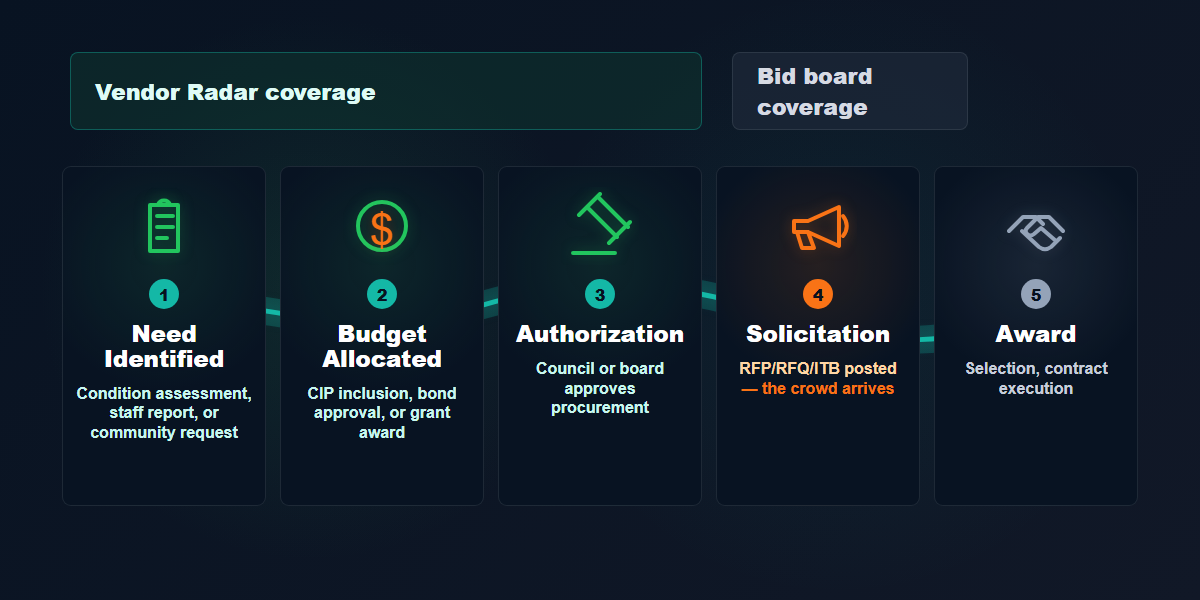
Local government procurement follows a predictable sequence. Each stage produces public documents that signal what's coming:
- Need identification — A department head, facilities director, or elected official identifies a need. This shows up in staff reports, committee discussions, and budget requests. At this stage, the project is real but informal.
- Budget authorization — The governing body (city council, county board, school board) includes the project in the annual budget or capital improvement plan. The project now has money attached.
- Scope development — Staff or a consultant develops the project scope, specifications, and evaluation criteria. For professional services, this may involve hiring a consultant to help define the need.
- Solicitation — The formal RFP, RFQ, or ITB is published. Depending on the dollar amount and procurement type, it may be advertised in newspapers, posted on the city website, or listed on bid notification services.
- Evaluation and selection — Responses are evaluated against published criteria. Professional services use qualifications-based selection; construction typically uses low bid; complex services use weighted scoring.
- Award and contract — The governing body votes to award the contract. The award appears in meeting minutes and is often reported in council action item summaries.
Who Makes the Buying Decisions
Local government purchasing involves multiple decision-makers at different stages:
| Role | Influence on purchasing |
|---|---|
| Department head / Director | Identifies needs, develops scope, recommends selection. Often the most influential person for your specific project. |
| City Administrator / County Administrator | Reviews and approves procurement over staff authority thresholds. Coordinates across departments. |
| Finance / Purchasing | Ensures procurement process compliance. Manages formal solicitation logistics. |
| Council / Board members | Approve budgets, authorize large contracts, vote on awards. Policy-level decisions. |
| Consultants / Architects / Engineers | For construction and infrastructure, the design consultant often influences contractor selection through specifications and pre-qualification recommendations. |
Small Purchases vs. Formal Procurement
Not every purchase goes through a full solicitation process. Most jurisdictions have tiered thresholds:
- Staff authority (under $5K-$25K) — Department heads can make purchases directly. No council approval, no formal bidding. These are relationship-driven.
- Informal quotes ($10K-$50K) — Staff obtains 2-3 quotes and selects based on price, qualifications, or availability. No public posting required in most jurisdictions.
- Formal solicitation (over $50K-$100K) — Full RFP/RFQ/ITB process with public notice, defined evaluation criteria, and council/board approval.
The insight here: a significant amount of government purchasing happens below the formal solicitation threshold. If you're only watching bid boards, you're only seeing the large projects that go through full public procurement.
What This Means for Service Firms
- Start early — the firms that win consistently engage during stages 1-2 (need identification and budget authorization), not stage 4 (solicitation). By the time you see the RFP, the government already has a mental shortlist.
- Relationships matter at every level — the department head defines the need, the administrator approves the process, and the council votes on the award. Understanding who influences your project type is essential.
- Process compliance is non-negotiable — missing a deadline, omitting a required form, or failing to meet a bonding requirement disqualifies you regardless of qualifications or price.
- Public documents are your intelligence — every stage of the buying process produces public records: agendas, packets, minutes, CIPs, budgets, and procurement postings. The firms that read them have a structural advantage.