How We Found It: School District Construction Signals Hidden in Board Meeting Packets
School districts are one of the largest buyers of construction, roofing, HVAC, and facility services in local government. The projects are big, the budgets are public, and the signals appear in board meeting documents months before any solicitation posts. But almost nobody reads those documents — because they're dense, unstructured, and buried in packet PDFs that run hundreds of pages.
This is the story of how Vendor Radar finds those signals.
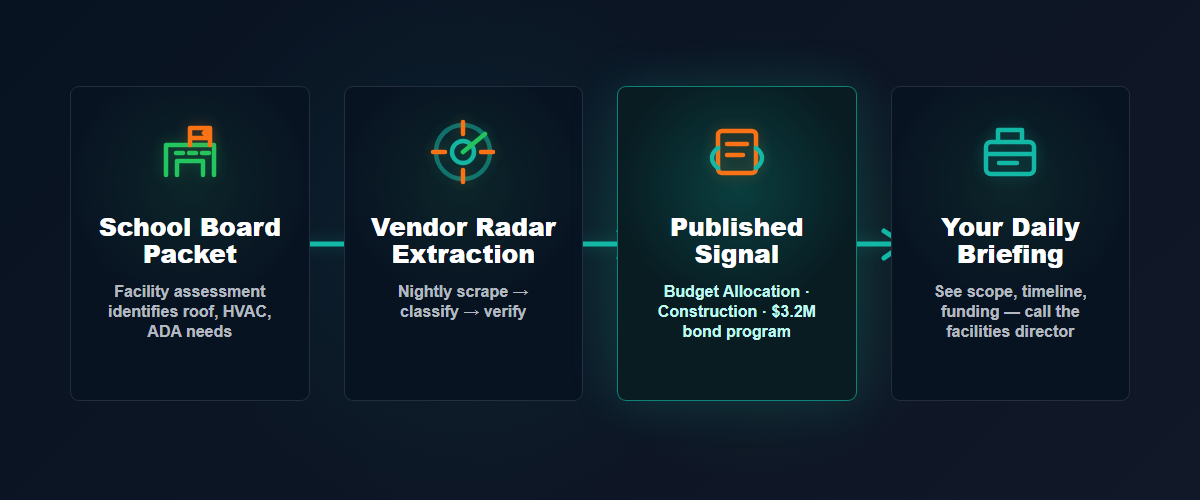
The Source: School Board Meeting Packets
Every school board in the Upper Midwest holds regular meetings — typically monthly or bi-monthly. Before each meeting, the district posts a packet containing:
- Superintendent's report — often mentions facility conditions, upcoming projects, and staffing for construction management.
- Facilities committee report — details on building conditions, deferred maintenance lists, and project status updates.
- Business manager's report — financial summaries, budget amendments, and fund transfers that signal capital spending.
- Action items — motions to approve architectural services, accept bids, award contracts, authorize bond sales, or approve facility assessments.
- Informational items — building condition reports, enrollment projections, and long-range facility plans that telegraph future projects.
A single school board packet can contain 200+ pages. Most contractors, engineers, and architects never read them.
What the Extraction Pipeline Finds
Vendor Radar's nightly scraping and extraction pipeline reads these packets and classifies the signals that matter:
- "Motion to approve Architects Inc. for facility assessment of Elementary #3 and the High School" — a facility assessment means the district is evaluating what needs work. Roof, HVAC, ADA, windows, and structural issues will all be identified, generating a prioritized list of construction projects.
- "Accept the facilities condition report and authorize staff to proceed with Phase 1 improvements" — this means the assessment is done and the district has committed to spending. Phase 1 will generate engineering, construction, and specialty trade contracts.
- "Award contract for Middle School roof replacement to [Contractor] in the amount of $847,000" — this is a bid award, useful for competitive intelligence. But the signal appeared in the facilities committee packet 9 months earlier as a budget line item.
- "Approve resolution calling for $12.5M building bond election" — this is the earliest and highest-value signal. A bond program will generate millions in construction, mechanical, electrical, and specialty trade work over 3-5 years.
The Timing Advantage
Here's the timeline contractors typically see versus what Vendor Radar surfaces:
| When | What's public | Who sees it |
|---|---|---|
| 18-24 months before | Long-range facility plan identifies aging buildings | Vendor Radar |
| 12-18 months before | Board authorizes facility condition assessment | Vendor Radar |
| 9-12 months before | Assessment results presented; bond resolution or CIP adoption | Vendor Radar |
| 6-9 months before | Architect/engineer selected for design | Vendor Radar |
| 3-6 months before | Plans and specs developed | Design team only |
| 0 months | ITB/RFP posted on bid board | Everyone (the crowd arrives) |
By the time the bid posts, the firms that have been tracking the project have already built relationships with the facilities director, understand the scope, and may have influenced the specifications through pre-design conversations.
Why School Signals Are Uniquely Valuable
- Predictable cycles — school buildings have 30-50 year lifecycles for roofs, 20-30 years for HVAC, and known deferred maintenance backlogs. The work is always coming.
- Public money — school district budgets are public. Bond programs, levy amounts, and facility budgets are all in board documents.
- Large scope — a single school district bond program can generate $5M-$50M+ in construction work across multiple buildings and trades.
- Consistent document structure — school board packets follow predictable formats, making extraction reliable and consistent.