How We Found It: Landscape and Park Project Signals
This is a source story. It shows the specific kind of signal Vendor Radar finds — and why a firm like a landscape architecture practice would care about it months before any RFP exists.
The Scenario
A landscape architecture firm in the Upper Midwest has three partners and a project designer. They sell park master planning, playground design, trail systems, streetscape improvements, and public engagement services to cities, counties, and park districts across North Dakota, South Dakota, Minnesota, and Montana. Their work depends on knowing which public bodies are about to need what they do.
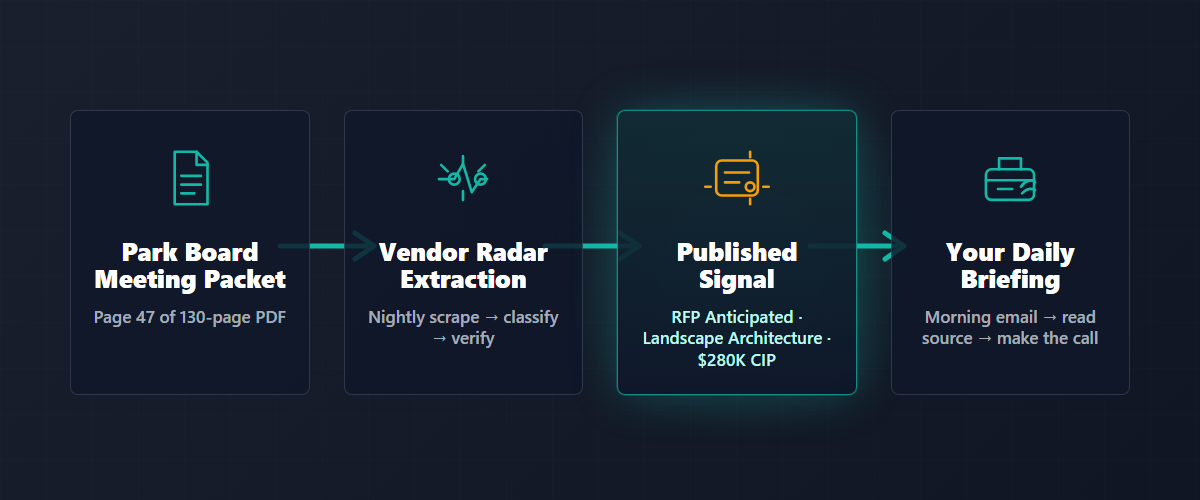
Here is the problem: a park board in a city of 12,000 people discusses a playground replacement at a Tuesday evening meeting. The discussion is in the consent agenda packet — page 47 of a 130-page PDF uploaded to a CivicPlus portal. No press release. No procurement posting. No formal RFP for months. The signal is public, but buried.
What the Document Says
The park board meeting packet includes a staff memo recommending the board authorize a feasibility study for replacing playground equipment at three neighborhood parks. The memo references a capital improvement plan line item of $280,000 for "park amenity lifecycle replacement." The board votes to authorize the study at the meeting.
This is a real pattern. Park boards and city councils across the Upper Midwest discuss these projects in public meetings routinely. The discussion is public record. But no landscape architecture firm finds it unless someone is reading that specific packet that week.
How Vendor Radar Finds It
Vendor Radar's nightly scraping cycle picks up the meeting packet from the CivicPlus agenda portal. The extraction pipeline reads the document, identifies the feasibility study authorization and the CIP budget reference, and produces a signal:
- Signal type: RFP Anticipated — the board authorized a study that will lead to consultant selection
- Service category: Landscape Architecture
- Government body: The city's park board
- Source document: Linked directly to the meeting packet PDF with the document date and meeting date
- Summary: A source-faithful description of what the board authorized, including the dollar amount and scope
The signal appears in the firm's daily briefing the next morning. The firm principal sees it, reads the source document, and calls the parks director before anyone else knows the project exists.
Why This Matters for Landscape Architects
Landscape architecture is a relationship business. The firms that win public park and public realm work are usually the ones who were in the conversation before the RFP was drafted. That means:
- Knowing a park board is thinking about playground replacement before the formal RFQ
- Understanding the budget context — $280K authorized in CIP versus "thinking about it someday"
- Being able to reference the specific meeting and document when you call the parks director
- Demonstrating familiarity with the community's parks system in your eventual proposal
None of this is possible if your only intelligence is a posted RFP that every firm in the region receives at the same time.
The Signal Types That Matter Most
For landscape architecture firms, the highest-value signals from local government documents are:
| Signal type | What it means | Example |
|---|---|---|
| Budget Allocation | Money has been set aside in a CIP or annual budget for a specific project or category | "$1.2M allocated in 2027 CIP for Riverside Park master plan implementation" |
| RFP Anticipated | A study, design, or construction project has been authorized and will need a consultant or contractor | "Board authorized staff to solicit proposals for trail design services" |
| Contract Expiring | An existing service agreement is approaching its end date | "Current parks maintenance contract expires September 2026; rebid recommended" |
| RFP Posted | A formal solicitation is live — still valuable as confirmation and for firms that missed the earlier signals | "RFP for Veterans Memorial Park redesign — proposals due July 15" |
| Bid Awarded | Shows who won, at what price, and establishes patterns for future work at that body | "Awarded Main Street streetscape Phase II to [firm] for $890K" |
Where the Signals Come From
Landscape and park project signals appear in public documents from a specific set of government bodies:
- Park boards and park districts — Operate independently from city government in many Upper Midwest jurisdictions. Have their own budgets, meetings, and procurement. Vendor Radar monitors them directly.
- City councils — Approve CIP budgets, authorize studies, and discuss project priorities in committee meetings.
- County boards — Fund trail systems, fairground improvements, and recreational facilities.
- School districts — Athletic fields, campus grounds, playground equipment, and site improvements.
The documents that carry these signals include meeting agendas, committee packets, staff memos, capital improvement plans, budget resolutions, and procurement pages. Vendor Radar has source-family adapters for CivicPlus, Legistar, BoardDocs, CivicClerk, QuestCDN, and custom government websites.
150 published landscape, park, and public realm signals across 121 government bodies — playground replacements, trail designs, park master plans, streetscape projects, and consultant selections extracted from public meeting documents.
Recent landscape and park signals:
- City of Marshfield · Wood, WI — Rfp Anticipated (Oct 14, 2026): Staff is seeking committee direction on the long-term future of the Upper Pond area at Wildwood Park and recommends a conceptual master plan before significant investment is mad... [source]
- City of Waterloo · Black Hawk, IA — Budget Allocation (Sep 21, 2026): The City of Waterloo Finance Committee agenda requests pre-authorization for Leisure Services to spend $4,450 on 20,000 pounds of unpainted rubber mulch for Sullivan Park. This ... [source]
- City of Falcon Heights · Ramsey, MN — Budget Allocation (Aug 26, 2026): At its August 26, 2026 budget workshop, the Falcon Heights City Council received a preliminary 2027 capital plan that proposes $10,500 for lighting and planting at the city's mo... [source]
Live proof refreshed October 19, 2026
The Pattern
This "how we found it" story is not a one-time event. It is the pattern:
- A government body discusses a project in a public meeting document.
- Vendor Radar's nightly extraction picks up the document, reads the relevant content, and produces a classified, source-linked signal.
- The signal appears in your dashboard and daily digest, matched to your service categories and territory.
- You read the source document, verify the opportunity, and make a call before the crowd shows up.
Every signal links back to the original public document. You can verify every claim before acting on it. That is the difference between intelligence and noise.
Try It With Your Territory
Pick a city where you already know the parks and landscape work. See if Vendor Radar surfaces signals you recognize — and signals you missed. The free tier gives you one city with no credit card and no time limit.