Government Procurement for Landscape Architects
Landscape architecture firms that sell to local government compete in a market with specific procurement patterns. Parks, trails, streetscapes, playgrounds, athletic fields, and public realm projects move through a predictable lifecycle in public meeting documents — but most firms only see the RFP at the end. This guide explains where the opportunities start and how to find them earlier.
Where Landscape Architecture Projects Originate
Local government landscape and public realm projects rarely begin with a posted RFP. They begin with one of these public-record events:
- Capital improvement plan adoption. A city or park district includes "Riverside Park Master Plan" or "Downtown Streetscape Phase III" in its 5-year CIP with a budget allocation and target year. This is often the earliest actionable signal.
- Park board or committee discussion. A parks and recreation committee discusses playground equipment lifecycle, athletic field drainage problems, or community requests for trail extensions. The discussion is in a meeting packet.
- Feasibility study authorization. A council or board authorizes staff to retain a consultant for site analysis, community engagement, or concept development. This is the moment before the RFQ is written.
- Grant or funding award. A body receives LWCF, state trail fund, or other grant funding earmarked for a specific park or public space project. The funding announcement creates procurement momentum.
- Contract expiration. An existing design or maintenance agreement approaches its term. The body must rebid or renew — either way, it is an opportunity for a firm paying attention.
The Procurement Timeline
Understanding the typical timeline helps you know when to act:
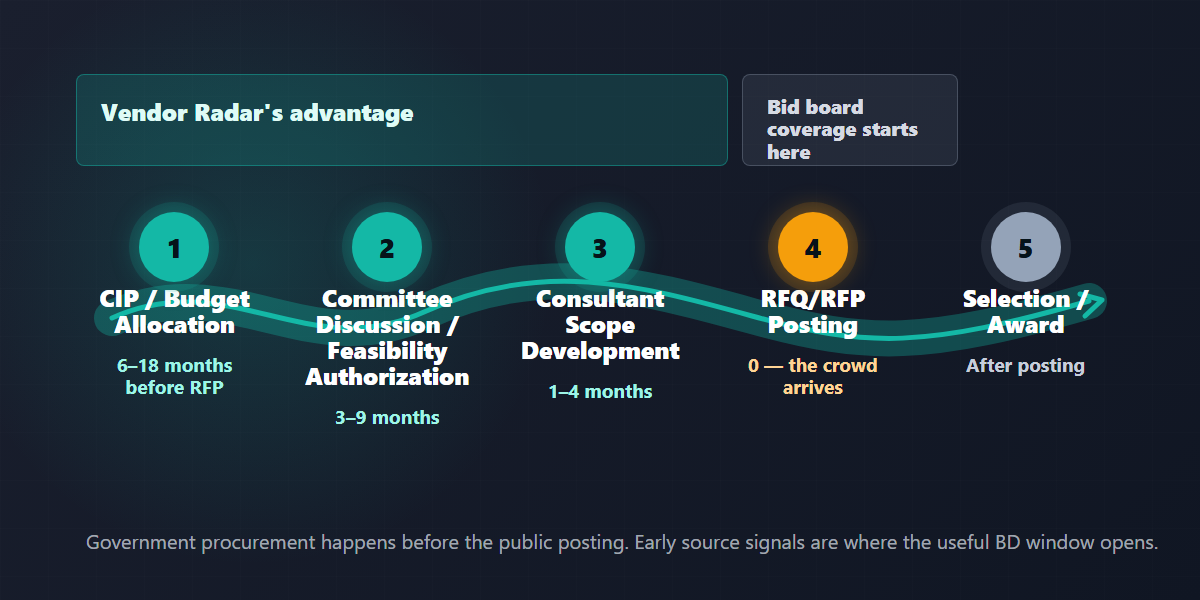
| Stage | Typical lead time before RFP | Where the signal appears |
|---|---|---|
| CIP inclusion / budget allocation | 6–18 months | Annual budget document, CIP plan, board resolution |
| Committee discussion / feasibility authorization | 3–9 months | Committee meeting minutes, staff reports, board packets |
| Consultant scope development | 1–4 months | Staff memos, committee updates (sometimes not public until RFP) |
| RFQ/RFP posting | 0 (the crowd arrives here) | Procurement page, QuestCDN, bid board |
| Selection / award | After posting | Board action item, meeting minutes, procurement page |
Most landscape architecture firms enter the picture at the RFQ/RFP posting stage. The firms that win consistently enter at the CIP or committee discussion stage.
What Makes Local-Gov BD Different for Landscape Architects
- Park boards operate independently. In many Upper Midwest jurisdictions, park boards and park districts have their own elected boards, budgets, and procurement processes separate from city government. If you only watch the city website, you miss the park board entirely.
- Projects are seasonal. Design work is typically procured in fall and winter for spring construction starts. Monitoring signals year-round means you see the budget discussion in February that leads to the RFP in October.
- Relationships matter more than price. Qualifications-based selection (QBS) is common for design services. Being the firm that already understands the community's park system and shows up informed is more valuable than being the lowest bidder.
- Small bodies have big projects. A park district in a town of 8,000 people might fund a $1.5M park renovation. The project is significant for any regional firm, but the body does not post to national databases.
- Repeat relationships are the business model. A successful park master plan leads to phased implementation, athletic field design, trail extensions, and maintenance planning. The first project is the door opener.
Project Types to Watch
These are the specific project types that appear as signals in public meeting documents:
- Park master plans and updates
- Playground equipment replacement and inclusive play design
- Trail system design, extensions, and connectivity studies
- Streetscape and downtown improvement projects
- Athletic field construction, renovation, and synthetic turf
- Public plaza, civic space, and memorial design
- Campus and school grounds improvements
- Irrigation system design and replacement
- Community engagement and public input processes
- Landscape restoration and stormwater management (green infrastructure)
- Fairground, cemetery, and special-facility site planning
150 published landscape, park, and public realm signals across 121 government bodies — playground replacements, trail designs, park master plans, streetscape projects, and consultant selections extracted from public meeting documents.
Recent landscape and park signals:
- City of Marshfield · Wood, WI — Rfp Anticipated (Oct 14, 2026): Staff is seeking committee direction on the long-term future of the Upper Pond area at Wildwood Park and recommends a conceptual master plan before significant investment is mad... [source]
- City of Waterloo · Black Hawk, IA — Budget Allocation (Sep 21, 2026): The City of Waterloo Finance Committee agenda requests pre-authorization for Leisure Services to spend $4,450 on 20,000 pounds of unpainted rubber mulch for Sullivan Park. This ... [source]
- City of Falcon Heights · Ramsey, MN — Budget Allocation (Aug 26, 2026): At its August 26, 2026 budget workshop, the Falcon Heights City Council received a preliminary 2027 capital plan that proposes $10,500 for lighting and planting at the city's mo... [source]
Live proof refreshed October 19, 2026
How Vendor Radar Helps
Vendor Radar monitors the park boards, city councils, county boards, and school districts that fund landscape architecture work. We read the agendas, packets, budgets, and procurement pages where these projects first appear in public — and surface the signals in your daily briefing matched to your service categories and territory.
Every signal links to its source document. You can verify the opportunity, understand the budget context, and make an informed call to the project contact.