How We Found It: Water Main Replacement Signals
This is a source story. It shows the specific kind of signal Vendor Radar finds in public works documents — and why a contractor or engineering firm would care about it months before any bid posting.
The Scenario
A mid-size civil engineering firm serves cities and counties across Minnesota and North Dakota. They design water main replacements, sewer rehabilitation, stormwater systems, and lift station upgrades. Their pipeline depends on knowing which cities are about to start infrastructure projects — and the problem is that most cities plan these projects quietly in public works committee meetings and annual CIP updates that nobody outside city hall is reading.
Here is a real pattern: a city of 18,000 people holds a public works committee meeting. Buried in the committee packet is an engineering assessment recommending replacement of 4,200 linear feet of cast iron water main in a residential neighborhood. The assessment estimates $2.1M in construction costs and recommends the city retain a design engineer. The committee votes to forward the recommendation to the full council.
What the Document Says
The public works committee packet contains a staff-prepared memo with an attached condition assessment from the city engineer. The assessment identifies failing pipe segments by street name, estimates replacement costs, and recommends the city authorize design engineering services for a 2027 construction start. The committee votes to recommend authorization to the full city council.
This recommendation is public record. It was discussed in an open meeting. The document is on the city's website. But no engineering firm or contractor outside the city's existing consultant relationship knows about it unless they happened to read that specific committee packet.
How Vendor Radar Finds It
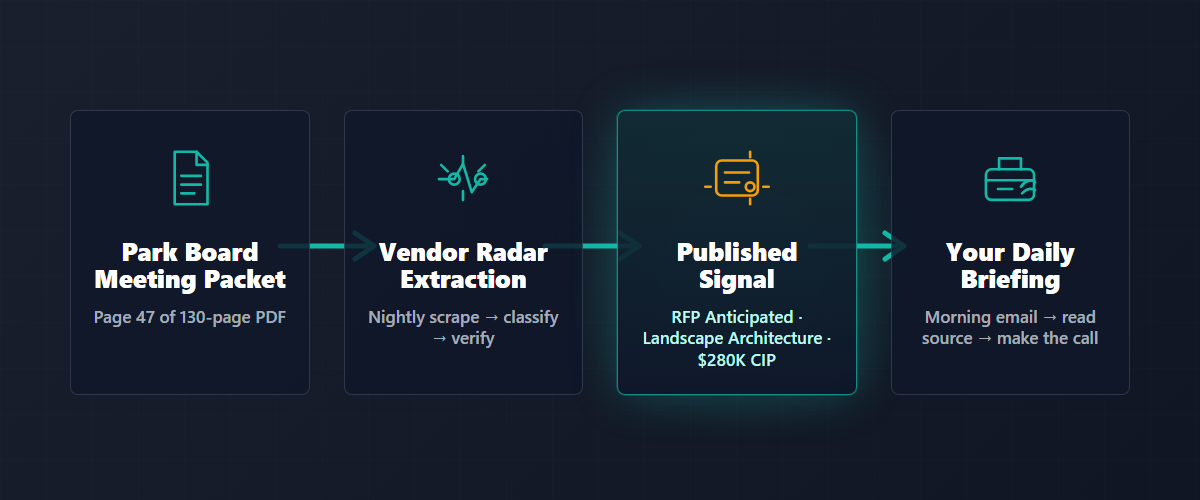
Vendor Radar's nightly scraping cycle picks up the committee packet from the city's document portal. The extraction pipeline reads the assessment, identifies the design authorization recommendation and the cost estimate, and produces a signal:
- Signal type: RFP Anticipated — the committee recommended authorizing design services
- Service category: Water & Sewer
- Government body: The city
- Source document: Linked directly to the committee packet PDF with the meeting date
- Summary: A source-faithful description of the recommendation, including the scope (4,200 LF water main), estimated cost ($2.1M), and recommended timeline
The signal appears in the firm's daily briefing the next morning. The principal engineer sees it, reads the source document, and understands the full project context before reaching out to the city engineer.
Why This Matters for Infrastructure Firms
Water and sewer work is the backbone of municipal engineering budgets. Cities replace water mains, line sewers, upgrade lift stations, and expand treatment capacity on predictable lifecycle timelines. The firms that win this work consistently are the ones who understand the project before the RFP lands:
- Knowing the scope (4,200 LF of cast iron) tells you whether this fits your capacity
- Knowing the estimated cost ($2.1M) tells you whether the budget is realistic for the scope
- Knowing the city already has an assessment tells you the project is real, not speculative
- Being able to reference the specific committee recommendation when you call the city engineer demonstrates credibility
The Signal Types That Matter Most
For water, sewer, and utility infrastructure firms, the highest-value signals from local government documents are:
| Signal type | What it means | Example |
|---|---|---|
| Budget Allocation | Money has been set aside in a CIP or annual budget for infrastructure work | "$3.4M allocated in 2027 CIP for Zone 3 water main replacement" |
| RFP Anticipated | A project has been authorized and will need design or construction services | "Council authorized staff to solicit proposals for sanitary sewer rehabilitation design" |
| Contract Expiring | An existing engineering or maintenance agreement is approaching its end | "Water treatment plant operations contract expires December 2026; rebid recommended" |
| RFP Posted | A formal solicitation is live — still valuable as confirmation | "RFP for lift station #7 replacement design — proposals due August 1" |
| Bid Awarded | Shows who won, at what price, and establishes competitive patterns | "Awarded 2nd Avenue water main replacement to [firm] for $1.8M" |
Where the Signals Come From
Water and sewer infrastructure signals appear in a specific set of documents:
- Public works committee packets — Where condition assessments, project recommendations, and design authorizations are first discussed.
- Capital improvement plans — Multi-year infrastructure investment plans that identify specific projects, budgets, and timelines.
- City council agendas and action items — Where design contracts, construction bids, and project change orders are approved.
- Utility rate study reports — Rate increases often signal upcoming capital programs. A rate study today means a construction program in 12-24 months.
- Annual budgets — Infrastructure line items in operating and capital budgets reveal the city's investment priorities.
330 published water, sewer, and utility infrastructure signals across 252 government bodies — water main replacements, sewer lining projects, lift station upgrades, stormwater improvements, and treatment plant expansions extracted from public meeting documents.
Recent water and sewer infrastructure signals:
- City of Three Forks · Gallatin, MT — Budget Allocation (Aug 23, 2026): The City of Three Forks’ FY2026–2027 water utility expenditure budget proposes a $5,000 increase for testing associated with new wells. The note appears under Professional Servi... [source]
- City of Taylorville · Christian County, IL — Rfp Anticipated (Sep 21, 2026): The City of Taylorville scheduled a council vote on a Water Committee motion to purchase 20 meters from Midwest Meter and authorize advertising bids for 124 additional meters. T... [source]
- City of Eyota, Minnesota · Olmsted, MN — Budget Allocation (Apr 9, 2026): The City of Eyota Council approved $20,000 per year from sanitary sewer funds to install concrete rings around manholes. Work will begin on eastern-side streets and prioritize n... [source]
Live proof refreshed October 18, 2026
The Pattern
This "how we found it" story is not a one-time event. Water main replacements, sewer rehabilitation, and utility upgrades follow predictable municipal lifecycle patterns across hundreds of government bodies. The pattern repeats:
- A city discusses an infrastructure need in a public works committee or council meeting.
- Vendor Radar's nightly extraction picks up the document, reads the relevant content, and produces a classified, source-linked signal.
- The signal appears in your dashboard and daily digest, matched to your service categories and territory.
- You read the source document, verify the project details, and make a call with full context.
Try It With Your Territory
Pick a city where you already do water or sewer work. See if Vendor Radar surfaces project signals you recognize — and signals you missed. The free tier gives you one city with no credit card and no time limit.