What Is a Capital Improvement Plan? The Document That Predicts Government Projects
A Capital Improvement Plan (CIP) is a multi-year planning document that lists the infrastructure projects a city, county, school district, or special district intends to fund and build. It is the single most valuable public document for firms that sell services to local government, because it tells you what's coming 1-5 years before the work is solicited.
What a CIP Contains
A typical CIP lists each planned capital project with:
- Project name and description — "Main Street Reconstruction, 1st Ave to 5th Ave" or "Wastewater Treatment Plant Expansion"
- Estimated cost — usually a planning-level estimate that tells you the project's scale
- Funding source — general fund, bond proceeds, state/federal grants, special assessments, utility revenue. This tells you how real the money is.
- Planned year — which fiscal year the project is budgeted to begin design, construction, or both
- Department or category — streets, water, sewer, parks, facilities, public safety. This tells you which department is the project owner.
How Cities and Counties Use CIPs
CIPs serve several purposes for local governments:
- Budget planning — CIPs force staff and elected officials to prioritize projects against available funding, creating a realistic pipeline of work.
- Debt planning — Many capital projects are bond-funded. The CIP is the justification for bond issuances and the spending plan voters approve.
- Coordination — If the water main under a street needs replacing and the street needs reconstruction, the CIP coordinates them into a single project rather than digging up the same street twice.
- Grant applications — Federal and state grant programs often require a CIP showing the project as a local priority.
- Transparency — CIPs are public documents. They are the government's way of telling residents and businesses what it plans to build and how it plans to pay for it.
Why CIPs Matter for Service Firms
For engineering firms, contractors, architects, and other service providers, the CIP is the earliest reliable signal that a project is real:
- A project in the CIP has been reviewed by staff, reviewed by a committee or commission, and adopted by the governing body. It has political support.
- A project in the CIP has an identified funding source. It's not just an idea — there's money attached.
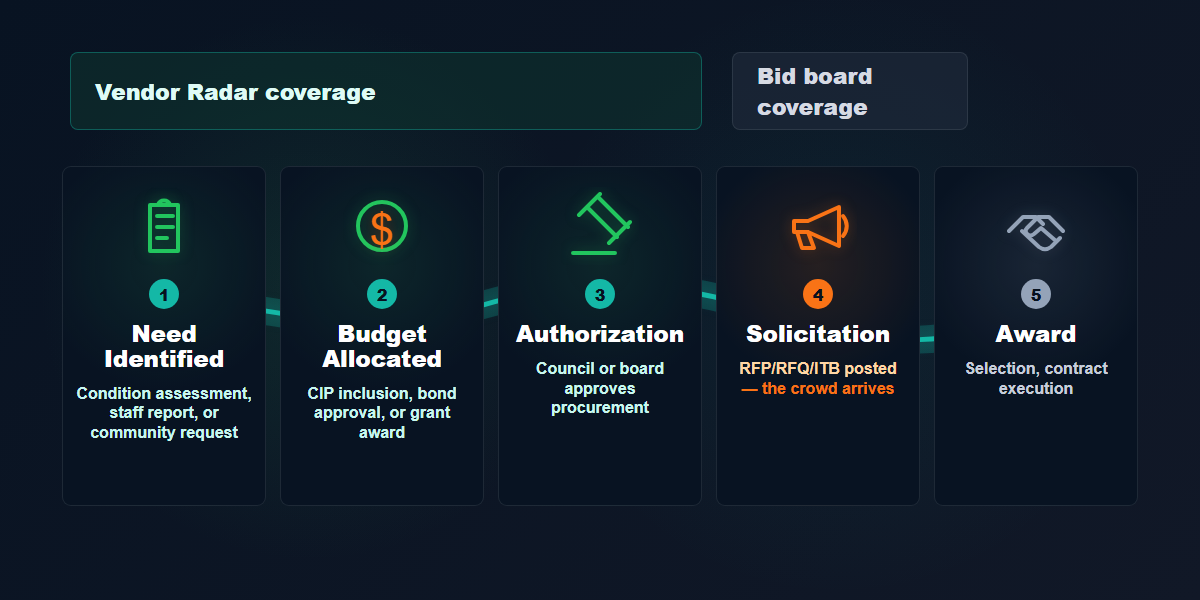
- CIP projects follow a predictable timeline. A project budgeted for design in Year 1 and construction in Year 2 tells you when the engineering RFQ and the construction bid will likely appear.
- CIPs are updated annually, so you can track whether a project moved forward, got delayed, or dropped off entirely.
CIP vs. Annual Budget
The annual operating budget and the CIP are different documents:
| Annual Budget | Capital Improvement Plan |
|---|---|
| One fiscal year | 5-10 year planning horizon |
| Day-to-day operations: salaries, supplies, services | Major infrastructure: roads, buildings, water/sewer, parks |
| Funded from taxes and fees | Often funded from bonds, grants, or special assessments |
| Service contracts may appear here | Design and construction contracts appear here |
Both documents carry signals. But the CIP is where multi-year infrastructure projects live, and those are the projects that generate the largest and most predictable contract opportunities.
How to Find CIP Documents
CIPs are public documents, but they're not always easy to find. Common locations include:
- City or county finance department web page
- Annual budget document (CIP is often an appendix)
- City council or county board meeting packets (CIP adoption is a formal agenda item, usually in the spring or fall)
- Planning commission or capital improvements committee packets
Vendor Radar automates this — our nightly extraction pipeline reads CIP documents, budget adoption packets, and committee reports from hundreds of government bodies and surfaces the specific projects and funding decisions that matter to your business.